Accountability Gaps in Enterprise Vendor Management: How to Stop Paying Premium Rates for Substandard Delivery
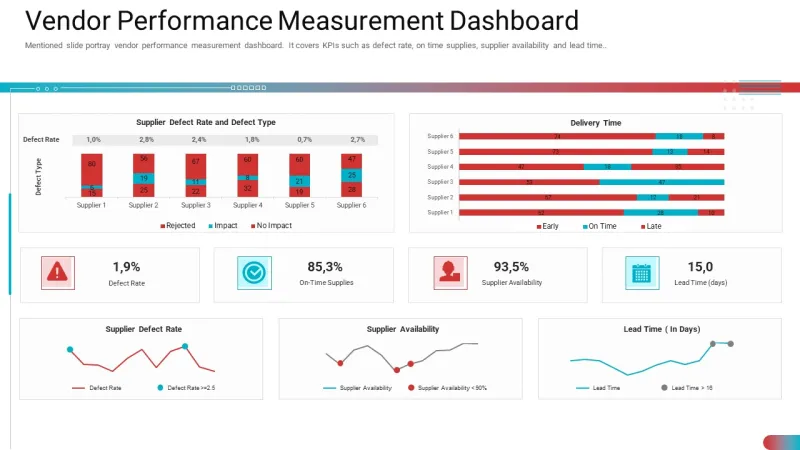
Photo: enterprise vendor contract negotiation business meeting performance metrics dashboard, via www.slidegeeks.com
The Renewal Default and What It Costs
There is a quiet, expensive habit embedded in enterprise procurement cycles across the United States: the automatic renewal. When a vendor contract approaches its expiration date, the default action in many large organizations is continuation. Switching costs feel prohibitive, internal champions of the original deal resist scrutiny, and the procurement team is already managing forty other priorities. So the contract renews, often at an increased rate, with little or no formal evaluation of whether the vendor has actually delivered what was originally promised.
This pattern is not rare. It is the operational norm at a significant share of US enterprises, particularly in software, professional services, and managed infrastructure. And it is costing those organizations more than most finance teams realize.
A 2024 analysis by Forrester found that enterprises with more than $50 million in annual vendor spend routinely carry between 18 and 27 percent of that spend in contracts where documented delivery performance falls measurably short of contractual commitments. At scale, that figure represents recoverable value in the tens of millions for many organizations—value that is being transferred to vendors who have learned that accountability mechanisms either do not exist or will not be enforced.
Why Initial Metrics Rarely Survive Real-World Conditions
The root of the problem begins before the contract is signed. Enterprise vendors—particularly in enterprise software and consulting—have become highly skilled at constructing sales narratives around metrics that look compelling in a controlled environment but do not translate to the buyer's specific operational context.
Implementation timelines presented during the sales cycle routinely assume ideal conditions: clean data, dedicated internal resources, minimal customization, and a technically sophisticated client team. None of those assumptions reliably hold in practice. A logistics company that contracted with a supply chain visibility platform in 2022 was quoted an eight-week implementation timeline. The actual go-live occurred at month seven, after three scope revisions and the engagement of a third-party implementation partner the original contract had not contemplated. The total cost of ownership in year one exceeded the original projection by 140 percent.
ROI projections carry similar risk. Vendors typically model returns under conditions that favor their product's strengths while understating integration complexity, change management requirements, and the time required for user adoption to reach a level where benefits actually materialize. By the time an enterprise realizes the promised ROI is not arriving on schedule, the contract is already signed and the vendor's leverage is at its peak.
Building an Outcome-Based Vendor Evaluation System
The solution is not to distrust vendors—it is to build evaluation infrastructure that makes performance visible, ongoing, and consequential. Enterprises that do this effectively share several structural characteristics.
They define success metrics before contract execution, not after. Every material vendor contract should include a set of agreed-upon Key Performance Indicators that are specific, measurable, and tied to the buyer's actual business outcomes—not to activity proxies the vendor controls. For a software vendor, relevant KPIs might include system uptime measured against the enterprise's own monitoring tools, user adoption rates at defined intervals, and documented process cycle time improvements in the functions the software was purchased to optimize.
They build measurement into operations, not just into contract language. A SLA clause that is never monitored is functionally worthless. Organizations that recover value from underperforming vendor relationships maintain a vendor performance dashboard that is reviewed by relevant stakeholders on a quarterly basis at minimum. This creates a documented record of performance that is essential when renegotiation becomes necessary.
They assign clear internal ownership for each significant vendor relationship. Vendor accountability gaps frequently persist because no single individual inside the enterprise is responsible for tracking performance and escalating shortfalls. Distributing that responsibility across procurement, IT, and the business unit creates diffusion of ownership where nothing gets resolved. Designating a named vendor relationship owner with explicit accountability for performance monitoring closes that gap.
They establish contractual remedies that have teeth. Performance credits, step-down pricing provisions triggered by missed SLAs, and defined exit rights tied to sustained underperformance are not adversarial terms—they are the structural incentives that align vendor behavior with buyer outcomes. Vendors who object strenuously to these provisions during negotiation are often signaling their own uncertainty about their ability to deliver.
Renegotiating from a Position of Documented Underperformance
For enterprises already locked into underperforming contracts, documented evidence of delivery shortfalls is a more powerful negotiating instrument than most procurement teams recognize. Vendors in enterprise relationships have strong incentives to retain accounts—churn is expensive, references are valuable, and case studies require cooperative clients. A well-prepared enterprise buyer that arrives at a renegotiation conversation with 12 months of performance data showing consistent gaps against contractual commitments is in a substantially stronger position than one that arrives with only a general sense of dissatisfaction.
A professional services firm that took this approach with a managed IT vendor in 2023 documented 22 instances of SLA breach over an 11-month period, quantified the internal cost of each incident, and presented that analysis in a formal renegotiation session. The outcome was a 19 percent reduction in annual contract value, an enhanced service credit structure, and a revised escalation protocol—all without changing vendors. The recovered spend across the remaining contract term exceeded $1.4 million.
The key to that outcome was documentation. Without a systematic measurement process already in place, the firm would have had no objective basis for the conversation.
Shifting the Relationship Dynamic at Scale
The broader strategic shift enterprise organizations need to make is from vendor management as an administrative function to vendor management as a value recovery discipline. Procurement teams that operate with clear performance frameworks, executive sponsorship, and the analytical infrastructure to quantify delivery gaps will consistently outperform those that treat contract renewals as routine paperwork.
This is not about creating adversarial vendor relationships. High-performing vendors welcome clear accountability structures because those structures provide a shared language for demonstrating value. The vendors that resist outcome-based frameworks are typically the ones with the most to lose from transparent measurement.
For enterprise leaders evaluating their current vendor portfolio, the starting question is straightforward: can your organization produce, today, a documented performance record for each of your top ten vendors by spend? If the answer is no, the accountability gap is almost certainly costing you more than you realize.